Calculate Your 7th Pay Matrix Salary
Wondering what is 7th pay matrix and how it affects your earnings? Get accurate salary calculations as per the 7th Pay Commission recommendations for Indian Government employees.
7th Pay Matrix Calculator
Your Monthly Salary
₹ 0.00
Monthly In-Hand Salary
7th CPC Pay Matrix Table
Level 1 to 5 (Grade Pay 1800 to 2800) – Pay Band-1 (5200 to 20200)
| # | Level 1 (GP 1800) | Level 2 (GP 1900) | Level 3 (GP 2000) | Level 4 (GP 2400) | Level 5 (GP 2800) |
|---|
Confused about how your salary is calculated under the 7th Pay Commission?
The 7th Pay Matrix simplifies everything into a clear, easy-to-understand system. Instead of complicated pay bands and grade pay, it uses a table where your salary is determined by your pay level and position (index) within that level.
This system is widely used by:
- Central government employees
- Defence personnel
- Railway employees
- Many PSU and autonomous bodies
What Is 7th Pay Matrix?
The 7th Pay Matrix is a standardized salary framework designed to bring simplicity, transparency, and uniformity to government pay structures.
In this system:
- Every job role is assigned a Pay Level (1 to 18)
- Each level contains Index values (steps of salary progression)
- Your basic pay = intersection of level + index
👉 This removes the need for:
- Pay Bands
- Grade Pay
- Complex calculations
Why Was the 7th Pay Matrix Introduced?
Before this system, salaries were calculated using:
- Pay Bands
- Grade Pay
- Complex percentage-based increments
This often created confusion among employees.
The 7th CPC introduced the matrix to:
- Simplify salary calculation
- Ensure transparency
- Standardize pay across departments
- Make increments predictable
Purpose of the 7th Pay Matrix
The new system was designed to improve both clarity and fairness in salary structures.
Key Objectives
1. Transparency in Pay Structure
Employees can clearly see how their salary is fixed and how it will grow over time.
2. Simplified Increments
Annual increments follow a fixed path—moving to the next index within the same level.
3. Uniform Salary Growth
Employees in similar roles receive consistent pay progression.
4. Fair Compensation
Pay reflects responsibility, experience, and position in a structured way.
Structure of the 7th Pay Matrix Explained
The pay matrix is presented in a table format with rows and columns.
Pay Levels
- Range from Level 1 to Level 18
- Represent hierarchy (entry-level to top अधिकारियों)
- Replace the old Grade Pay system
Each level corresponds to a specific job role and responsibility.
Pay Index (Stages)
- Represented as 1, 2, 3, 4…
- Show progression within a level
- Each index has a fixed salary value
👉 When you get an annual increment, you move to the next index.
👉 When you get a promotion, you move to a higher level.
How to Read the Pay Matrix
- Identify your Pay Level
- Find your Index Value
- The intersection shows your Basic Pay
This eliminates confusion and makes salary tracking easy.
Who Is Covered Under the 7th Pay Matrix?
The pay matrix applies to a wide range of employees:
- Central Government employees
- Defence personnel (officers & other ranks)
- Railway employees
- Employees of certain autonomous bodies
Important Note
- State government employees are not automatically included
- States may adopt or modify the structure separately
- Always check official notifications for confirmation
How Salary Is Calculated Using the 7th Pay Matrix
Salary calculation follows a simple and logical process.
Step-by-Step Calculation
Step 1: Add old basic pay + grade pay
This gives your total previous salary base.
Step 2: Apply fitment factor (2.57)
Multiply the total by 2.57 to get revised pay.
Step 3: Find Pay Level
Your old grade pay determines your new level.
Step 4: Match with matrix value
Choose the nearest higher value in the matrix.
Example Calculation
- Old Basic Pay: ₹10,000
- Grade Pay: ₹4,200
- Total: ₹14,200
After applying fitment factor:
₹14,200 × 2.57 = ₹36,494
👉 Nearest value in matrix: ₹36,500
👉 This becomes your new basic pay
Future increments will move horizontally within the same level.
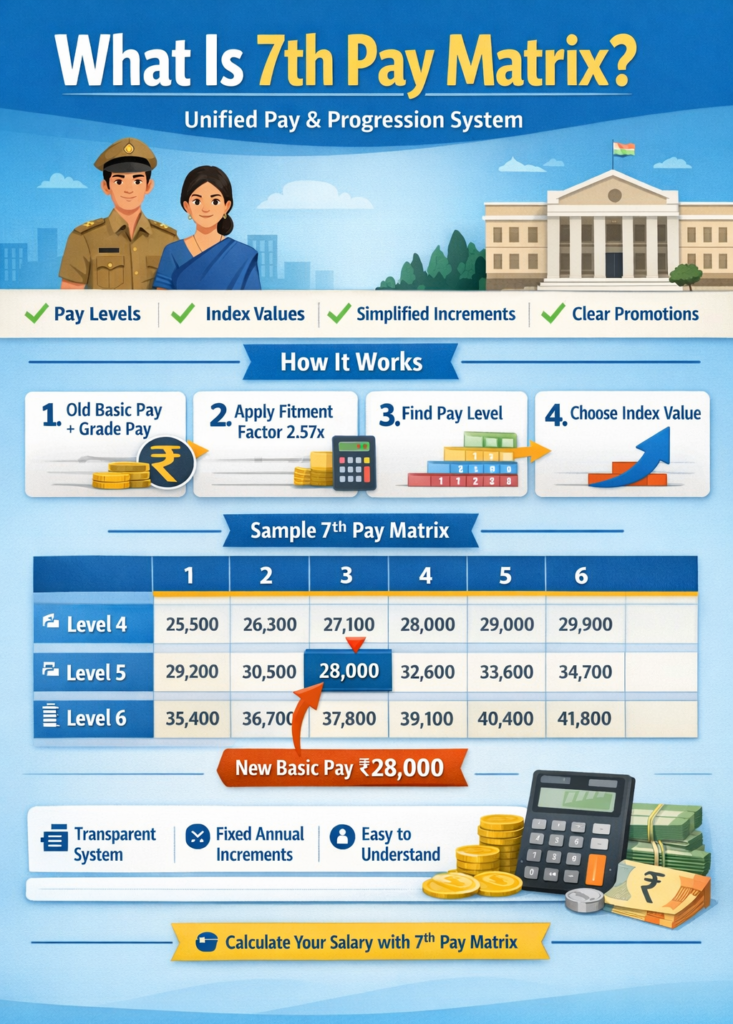
7th Pay Matrix Calculator – Calculate Your Salary Instantly
A 7th Pay Matrix Calculator helps you determine your salary without manual calculations.
Inputs Required
- Pay Level
- Current Basic Pay
- Index (optional)
Outputs You Get
- Revised Basic Pay
- Pay Level & Index
- Salary progression insight
Using a calculator saves time and ensures accuracy.
Advantages of the 7th Pay Matrix
The system offers several practical benefits:
Simplified Structure
No more complex pay bands—just levels and index values.
Clear Promotions
Salary increases are clearly defined when moving to a higher level.
Predictable Increments
Annual growth follows a fixed and transparent pattern.
Easy Understanding
Employees can easily track their salary without expert help.
Reduced Errors
Predefined values minimize calculation mistakes.
Difference Between 6th Pay Commission and 7th Pay Matrix
| Feature | 6th Pay Commission | 7th Pay Matrix |
|---|---|---|
| Pay Bands | Yes | No |
| Grade Pay | Yes | Removed |
| Structure | Complex | Simplified |
| Increment | Percentage-based | Index-based |
The 7th Pay Matrix is more transparent, structured, and user-friendly.
Common Questions About What Is 7th Pay Matrix (FAQ)
Before answering the most frequently asked questions, it is important to clearly understand what is 7th pay matrix and why employees often search for this term. The 7th pay matrix is the foundation of salary calculation for central government staff under the 7th Central Pay Commission. It defines how basic pay is fixed, how increments are granted, and how promotions impact salary. Many employees, pensioners, and job aspirants look for what is 7th pay matrix, 7th pay matrix levels, and 7th pay matrix salary calculation to better understand their current and future earnings. The following FAQs address the most common doubts in simple and clear language.
What is the 7th Pay Matrix in simple terms?
It is a salary table that shows how much a government employee earns based on their level and experience stage.
How many levels are there?
There are 18 levels, from Level 1 (entry-level) to Level 18 (top अधिकारियों).
What is the fitment factor?
It is a multiplier (2.57) used to convert old salary into revised pay.
Is DA included in the matrix?
No. Dearness Allowance (DA) is calculated separately as a percentage of basic pay.
Can state government employees use it?
Only if their state officially adopts the 7th Pay Commission structure.
Important Notes & Disclaimer
The information provided on what is 7th pay matrix and related salary calculations is for general guidance only. All salary figures shown through explanations or calculators are indicative and estimated, not final or legally binding.
- All calculations are indicative, not final
- Final salary depends on:
- Government notifications
- Department rules
- Promotions and service conditions
Always verify with official circulars or your accounts department.
Conclusion
The 7th Pay Matrix is a major reform that transformed how government salaries are structured and calculated. By replacing complex pay bands with a clear system of levels and index values, it has made salary progression more transparent and predictable.
Whether you are tracking your current salary or planning future growth, understanding the pay matrix gives you complete clarity over your earnings. Using a reliable calculator further simplifies the process, helping you estimate your salary instantly and accurately.